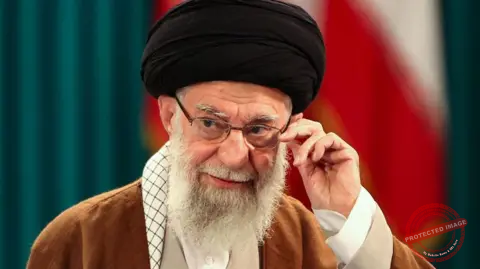
Iran’s state media has confirmed the death of Supreme Leader Ayatollah Ali Khamenei following large-scale joint military strikes carried out by the United States and Israel, marking one of the most consequential geopolitical developments in modern Middle Eastern history.
The announcement, broadcast early Sunday, declared the 86-year-old cleric had reached “martyrdom” after coordinated attacks struck leadership and military sites in Tehran. Authorities immediately declared 40 days of national mourning as crowds gathered across cities reacting with grief, anger, and uncertainty over the country’s future.
The development was first publicized internationally by U.S. President Donald Trump, who said the operation was intended to cripple Iran’s strategic command structure. He described the strike as a decisive blow against what he called decades of destabilizing regional activity.
Israeli Prime Minister Benjamin Netanyahu confirmed that Israeli forces had targeted high-level leadership compounds and military command infrastructure, saying intelligence indicated Khamenei and several senior officials were present at the time of the strikes. Defense officials said the operation focused on command-and-control centers linked to Iran’s military and nuclear establishment.
Regional tensions escalated rapidly within hours of the confirmation, as Iranian forces launched retaliatory missile and drone attacks toward Israeli territory and U.S. military installations across parts of the Middle East. Iranian commanders warned that what they described as the “ultimate response” was still to come, raising fears of a widening regional war.
Security analysts say Khamenei’s death creates a historic leadership vacuum inside Iran’s political system. Having ruled since 1989, he was the ultimate authority over military, judiciary, and political institutions. While Iran’s constitution provides a succession mechanism involving senior clerics and governing bodies, experts warn that internal rivalries among powerful factions — especially the Revolutionary Guard — could shape the next phase of power.
Global markets and diplomatic circles are closely monitoring developments, particularly due to concerns that instability could threaten energy flows through the Strait of Hormuz, a vital corridor for global oil shipments. International leaders have called for urgent restraint as emergency diplomatic efforts intensify.
Khamenei’s death signals a historic turning point not only for Iran but for the geopolitical balance of the Middle East, with the coming days expected to determine whether the region moves toward wider conflict, internal upheaval within Iran, or fragile negotiations aimed at de-escalation.

 Shola Akinyele
151 Views
Shola Akinyele
151 Views













 WhatsApp us