Julius Malema Hails Nigeria’s Banks and Afrobeats, Sparks Africa-Wide Debate: ‘Learn From Nigerians, Stop Wielding Pangas’
Julius Malema praises Nigeria’s banking sector and Afrobeats stars Burna Boy and Wizkid, sparking a viral Africa-wide debate on economic empowerment and xenophobia.
South African opposition leader Julius Malema has triggered widespread reactions across Africa after praising Nigeria’s banking and entertainment industries as examples of Black economic success, while urging South Africans to focus on wealth creation rather than violence and unproductive protests.
The remarks, which went viral across social media in mid-July 2026, were widely shared on Facebook, X, Instagram and TikTok, attracting millions of views and igniting heated conversations between Nigerians and South Africans.
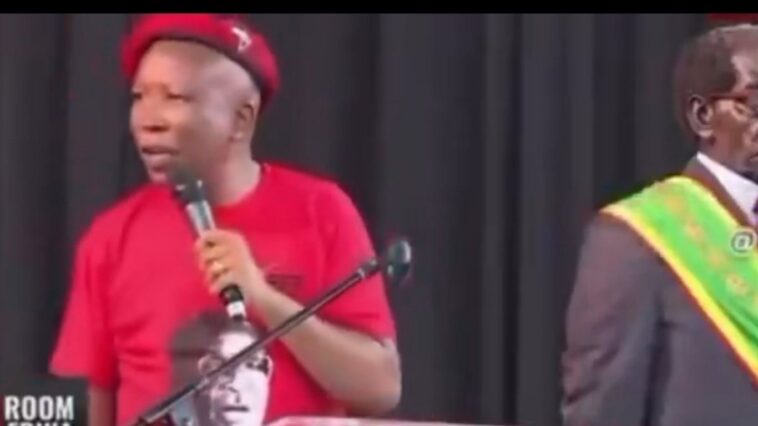
Speaking during a recent public address, the leader of South Africa’s Economic Freedom Fighters (EFF) commended Nigeria for producing globally respected financial institutions and internationally acclaimed music stars.
Malema highlighted indigenous Nigerian ownership and leadership of major financial institutions, citing United Bank for Africa (UBA) under businessman Tony Elumelu and Zenith Bank, founded by Jim Ovia, as examples of Black excellence in business and entrepreneurship.
According to Malema, Nigeria has demonstrated that Africans can build and own world-class financial institutions capable of competing internationally.
He also praised Nigeria’s entertainment industry, saying Afrobeats superstars such as Burna Boy, Wizkid, and other Nigerian artists now compete successfully on the global stage, including against American music stars.
Malema contrasted these achievements with what he described as a culture in South Africa where some people resort to carrying “pangas”—machetes commonly associated with violent protests and xenophobic attacks—instead of developing businesses, acquiring skills and creating economic opportunities.
His comments appeared to encourage South Africans to pursue entrepreneurship, innovation and economic ownership rather than blaming immigrants or engaging in violence.
The speech quickly gained traction online, particularly among Nigerian audiences, who celebrated Malema’s recognition of the country’s achievements in banking, music and broader economic development.
Many Nigerians described the remarks as an acknowledgment of the country’s growing influence across Africa, pointing to the global success of Nigerian banks, Afrobeats, Nollywood and technology entrepreneurs.
However, the speech also generated mixed reactions in South Africa.
While some South Africans agreed with Malema’s call for greater self-reliance and condemned xenophobic violence, others argued that his comparison oversimplified the realities facing both countries.
Critics noted that Nigeria, despite its internationally successful banking and entertainment sectors, continues to face significant challenges, including insecurity, poverty, inflation, infrastructure deficits and governance concerns.
Others also pointed out that South Africa remains one of Africa’s leading economies with globally recognised industries in finance, mining, manufacturing and telecommunications.
Fact-checking of Malema’s comments found that the central examples he cited are broadly accurate.
Nigeria’s banking industry is largely controlled by indigenous investors and executives, with institutions such as UBA and Zenith Bank expanding across Africa and becoming major players in the continent’s financial sector.
Similarly, Nigeria’s entertainment industry has become one of Africa’s strongest cultural exports. Artists including Burna Boy, Wizkid and Davido have earned Grammy recognition, topped international charts, collaborated with global stars and sold out arenas across Europe, North America and beyond. Nollywood also remains one of the world’s largest film industries by production volume.
Although Malema’s remarks were framed as political rhetoric designed to encourage economic empowerment, analysts say they reflect a broader conversation about African development, Black ownership, entrepreneurship and regional cooperation.
The viral speech has also reignited debates over xenophobia, migration and the relationship between Africa’s two largest economies.
Malema, a longtime advocate of pan-Africanism, has consistently argued that African nations should work together to strengthen economic independence rather than turning against one another.
His latest remarks have once again placed Nigeria’s growing influence in banking, entertainment and business at the centre of continental discussions on African excellence and economic transformation.
















 and then
  WhatsApp us