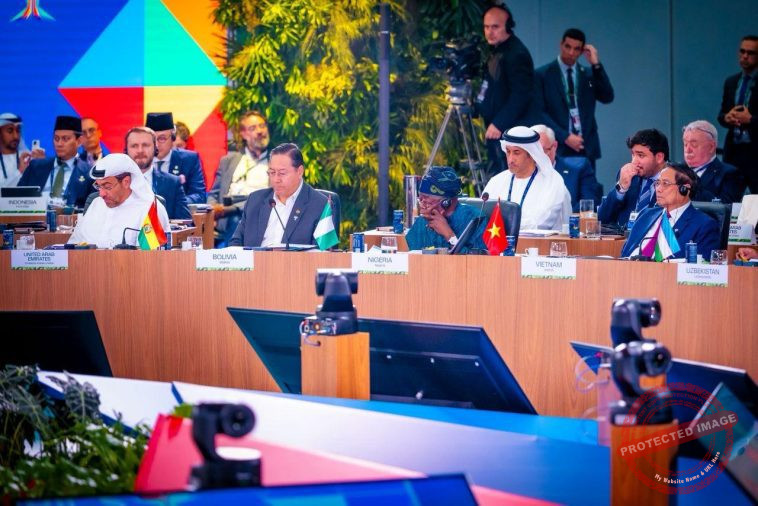
President Bola Ahmed Tinubu made headlines on Monday, July 7, as he led Nigeria’s delegation to the 17th BRICS Summit in Rio de Janeiro, Brazil. The event marked Nigeria’s first official participation as a BRICS partner country since its elevation to the status in January 2025. Tinubu arrived in grand style, accompanied by five state governors—Dapo Abiodun (Ogun), Babajide Sanwo-Olu (Lagos), Hyacinth Alia (Benue), Sheriff Oborevwori (Delta), and Umar Bago (Niger)—alongside two federal ministers.
While delivering what many described as a powerful and inspiring address, President Tinubu advocated for a more inclusive global governance structure that genuinely reflects the needs and voices of African nations. He emphasized the urgency of reforms in international finance, healthcare access, and climate justice, calling on BRICS leaders to create a more equitable world where no country is left behind. Tinubu also highlighted Nigeria’s commitment to green growth, digital transformation, and sustainable development, positioning the country as a key player in the South-South cooperation movement.
However, the summit took on a more intense geopolitical tone following former U.S. President Donald Trump’s announcement of an additional 10% export tariff on all countries associated with BRICS.
The announcement sparked immediate controversy, as Nigeria, now a BRICS partner, would be directly affected. Trump claimed that BRICS member and partner nations were aligning with anti-American economic policies, though he failed to provide specific details backing his claim. His announcement sent ripples through diplomatic circles, reigniting debates on global trade fairness and U.S. economic protectionism.
Nigeria’s Minister of Industry, Trade, and Investment had earlier warned in April that any such tariff policy could significantly disrupt trade relations and negatively affect Nigeria’s export economy. The new tariff means Nigerian exporters may face increased costs on goods shipped to the U.S., further challenging a fragile economy already contending with inflation and currency volatility.
BRICS—originally made up of Brazil, Russia, India, China, and South Africa—expanded in 2024 with the inclusion of Egypt, Ethiopia, Indonesia, Iran, Saudi Arabia, and the United Arab Emirates. In January 2025, Nigeria was officially recognized as a BRICS partner alongside Belarus, Bolivia, Cuba, Kazakhstan, Malaysia, Thailand, Uganda, and Uzbekistan. Indonesia was upgraded to full member status during the same period.
President Tinubu’s appearance at the summit is seen by many analysts as a signal of Nigeria’s ambition to deepen international partnerships outside traditional Western spheres. His administration continues to push for Nigeria’s eventual full membership in the BRICS bloc, aligning with a growing number of Global South nations seeking to shift the balance of economic and political power.
As tensions between BRICS nations and Western powers continue to build, Nigeria’s strategic positioning within the alliance may offer both opportunities and challenges. For now, Tinubu’s rousing speech and strong presence in Rio have boosted the country’s diplomatic visibility and sparked critical conversations on global economic equity.

 Shola Akinyele
309 Views
Shola Akinyele
309 Views













 WhatsApp us